Extinguisher Fire Risk Assessments –
Many businesses in Leeds still take a generic approach to fire extinguishers — installing the same equipment across every part of the building regardless of the actual fire risks present. In reality, extinguishers should never be selected at random or simply copied from another premises. The correct approach is to ensure that fire risk assessments directly determine extinguisher type, quantity and positioning.
A fire risk assessment identifies:
- potential ignition sources
- combustible materials
- operational hazards
- escape routes
- and areas where fires are most likely to start
Without this assessment, businesses risk installing extinguishers that are unsuitable for the environment.
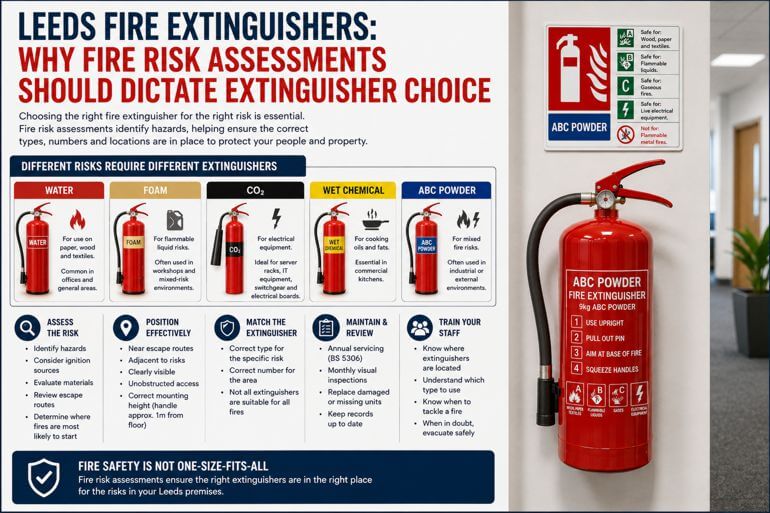
Different Risks Require Different Extinguishers
One of the biggest misconceptions is that all extinguishers perform the same role. In fact, each type is designed for very specific fire classes.
Typical extinguisher applications include:
- Water extinguishers
- suitable for paper, wood and textile fires
- common in offices and general commercial spaces
- Foam extinguishers
- designed for flammable liquid risks
- often used in workshops and mixed-risk environments
- CO2 extinguishers
- intended for electrical equipment
- commonly installed near:
- server racks
- IT equipment
- switchgear
- electrical distribution boards
- Wet chemical extinguishers
- designed specifically for cooking oils and fats
- essential in commercial kitchens
- ABC powder extinguishers
- suitable for mixed fire risks
- often used in industrial or external environments
A Leeds warehouse, restaurant and office block may all require completely different extinguisher strategies despite operating within the same city.
Incorrect Extinguisher Selection Can Increase Risk
Using the wrong extinguisher can make a fire worse rather than better.
For example:
- water extinguishers should never be used on live electrical equipment
- incorrect extinguishers in kitchens can spread burning oils
- powder extinguishers may not be suitable for enclosed occupied spaces due to visibility concerns
This is why extinguisher provision should always follow professional fire risk assessment findings rather than assumptions.
Positioning Is Part of the Assessment Process
Risk assessments do not only identify extinguisher type — they also determine where extinguishers should be positioned.
Correct positioning typically includes:
- near escape routes
- adjacent to identified hazards
- clearly visible locations
- accessible mounting heights
- unobstructed access
In Leeds commercial premises, layout changes frequently create problems where extinguishers become hidden behind:
- stock
- furniture
- machinery
- or temporary storage
Regular reviews help ensure positioning remains effective.
Multi-Risk Buildings Need Zoned Protection
Many modern commercial premises contain multiple risk areas within the same building.
Examples include:
- offices with kitchenettes
- workshops with electrical equipment
- retail units with stockrooms
- mixed-use industrial spaces
Each area may require:
- different extinguisher types
- separate signage
- individual positioning strategies
This “zoned” approach creates more effective protection throughout the premises.
Servicing and Maintenance Remain Essential
Even correctly selected extinguishers become ineffective if they are not maintained properly.
Businesses in Leeds should ensure:
- annual servicing is completed
- monthly visual inspections are carried out
- damaged extinguishers are replaced promptly
- signage remains clear and compliant
Maintenance records should also be retained to support compliance requirements.
Staff Awareness Matters
Extinguishers are only effective if staff understand:
- where they are located
- which type should be used
- when it is safe to tackle a fire
- and when evacuation is the safer option
Basic fire safety training significantly improves emergency response confidence.
Fire Safety Should Never Be Generic
No two commercial premises have identical risks. Effective extinguisher provision should always reflect:
- the building layout
- operational activities
- equipment present
- and occupancy type
For businesses in Leeds, fire risk assessments provide the foundation for safer, compliant and more effective extinguisher protection. By matching extinguishers to real-world risks rather than assumptions, businesses can improve both safety and emergency preparedness.
Frequently Asked Questions
How often should fire extinguishers be serviced?
Commercial fire extinguishers should normally be serviced annually by a competent engineer in line with BS 5306.
Are all fire extinguishers suitable for electrical fires?
No. CO2 extinguishers are typically used for live electrical equipment. Water extinguishers should not be used on electrical fires.
Can one extinguisher type cover every risk?
Usually not. Most commercial premises require a combination of extinguisher types depending on the hazards present.