
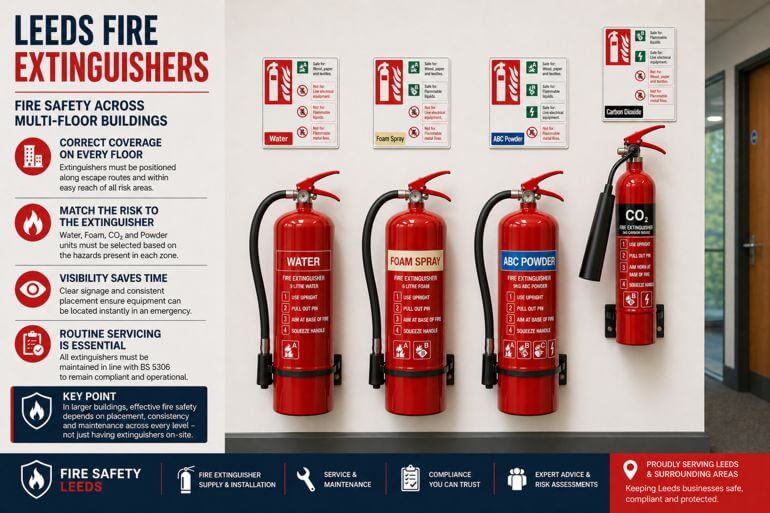
Leeds Fire Extinguishers Multi-Floor –
For businesses in Leeds operating from larger premises — such as office blocks, multi-floor buildings, retail units or mixed-use developments — fire extinguisher provision becomes significantly more complex. It is no longer just about having the right types on-site, but about ensuring coverage, accessibility and consistency across the entire building.
One of the main challenges in larger Leeds premises is coverage across multiple floors and zones. A single extinguisher or poorly distributed units will not provide adequate protection. Instead, extinguishers must be positioned so that they are always within a reasonable distance of any potential fire risk, ensuring they can be accessed quickly in an emergency.
This requires a structured approach. Each floor should be treated as a separate risk area, with extinguishers placed along escape routes, near exits and close to identified hazards. In Leeds commercial buildings with multiple levels, this ensures that staff are never too far from appropriate fire-fighting equipment.
Different areas of the building often present different risks. Offices may require water or foam extinguishers, while plant rooms, server areas or kitchens may require CO2 or specialist units. This means that extinguisher provision must be zoned according to risk, rather than applied uniformly across the building.
Stairwells and escape routes are particularly important. These areas must remain accessible and protected, as they are critical for safe evacuation. Extinguishers positioned along these routes can help manage small fires that may otherwise block exits.
Visibility is essential in larger premises. Extinguishers must be clearly identifiable, with appropriate signage to ensure they can be located quickly. In Leeds buildings with complex layouts, clear signage is critical in guiding users to the nearest equipment.
Consistency in installation also matters. Units should be mounted at the correct height and positioned in a uniform way throughout the building. This ensures that staff can locate and use them instinctively, even in unfamiliar areas.
Maintenance becomes more demanding in larger properties. With multiple extinguishers spread across different floors and zones, it is essential to maintain a structured servicing schedule. Each unit must be inspected and serviced regularly in line with BS 5306 standards to ensure reliability.
Record keeping is particularly important in these environments. Businesses must maintain clear documentation showing that all extinguishers have been serviced and inspected correctly. This is essential for compliance and for demonstrating due diligence.
Regular visual inspections should also be carried out internally. In busy Leeds commercial buildings, extinguishers can be moved, obstructed or damaged without being noticed. Routine checks help ensure that all units remain accessible and in good condition.
Staff awareness is another key factor. In multi-floor buildings, employees may not be familiar with all areas of the premises. Basic fire safety training ensures that staff understand where extinguishers are located and how to use them safely.
Coordination with other fire safety systems is essential. Fire extinguishers should be integrated into a wider strategy that includes fire alarms, emergency lighting and evacuation procedures. In larger Leeds buildings, this coordinated approach ensures that all elements of fire safety work together effectively.
Fire extinguishers should always be used as a first response measure, intended to control small fires in their early stages. In larger premises, this early intervention can prevent a minor incident from escalating into a major emergency.
Risk assessments must be reviewed regularly, particularly if the building layout or use changes. Expanding businesses, reconfigured office spaces or new equipment can all introduce new fire risks that require updated extinguisher provision.
For businesses in Leeds, managing fire extinguishers across larger and multi-floor premises requires a more strategic approach. By focusing on coverage, zoning, visibility and maintenance, businesses can ensure that their fire safety systems are both compliant and effective.


